Key figures
The MiNeco system
Affordable isn't one trick. It's the combination.
MiNeco is coined from Minimum Eco-friendly. A building only becomes genuinely affordable and effective when three things are considered together: the design, the ground conditions, and the location. Get any one wrong and the building system alone can't save the budget.
On top of that, Mineco looks at a building as a whole — not just its walls — and works to lower the cost of every structural element: foundation, walling, structural grid, slab, roof and finishes.
Design, ground & location first
A technical site visit and soil assessment inform the foundation choice before a plan is finalised. Architectural and structural drawings, and a bill of quantities, are drawn up around what the specific site actually needs — using the latest CAD software.
Then, cost lowered at every element
Foundation, walling and slab each carry their own share of a build's cost. Mineco's precast system is engineered to cut each one individually — not just swap one expensive step for another.
| Element | Typical share of build cost | Mineco approach | Cost lowered by |
|---|---|---|---|
| Foundation | 20–30% | Suspended precast foundation | 30–40% |
| Walling | 15–20% | HICB interlocking blocks | ~30% |
| Slab | — | Precast waffle slab | 30–35% |
| Roof | — | Light steel roofing | ~20% |
| Structural grid | — | Beams & columns cast inside hollow blocks | No separate formwork or frame cost |
| Finishes | — | The Shell option | Client controls finish spend & timing |
Cost-lowered figures are against conventional strip-footing, quarry-stone-and-mortar, and timber-roof construction for the same element.
Get a live estimate
What would your build cost?
Based on real completed-project averages — Shell and Standard finish, per square metre.
Budget option
"The Shell"
The simplest complete form of a Mineco House structure: roof cover, plastered wall surfaces, window and door frames, electrical conduiting, plumbing pipes, cement-sand screed, and steel front and rear doors — deliberately leaving finishes out so clients can choose their own within their budget.
How we build
No mortar. No plaster. No wasted days.
Hollow interlocking concrete blocks key into each other without mortar joints — cutting labour and construction time while staying strong, durable and eco-friendly. Beams and columns are cast directly inside the hollow cores, so no separate formwork is needed.
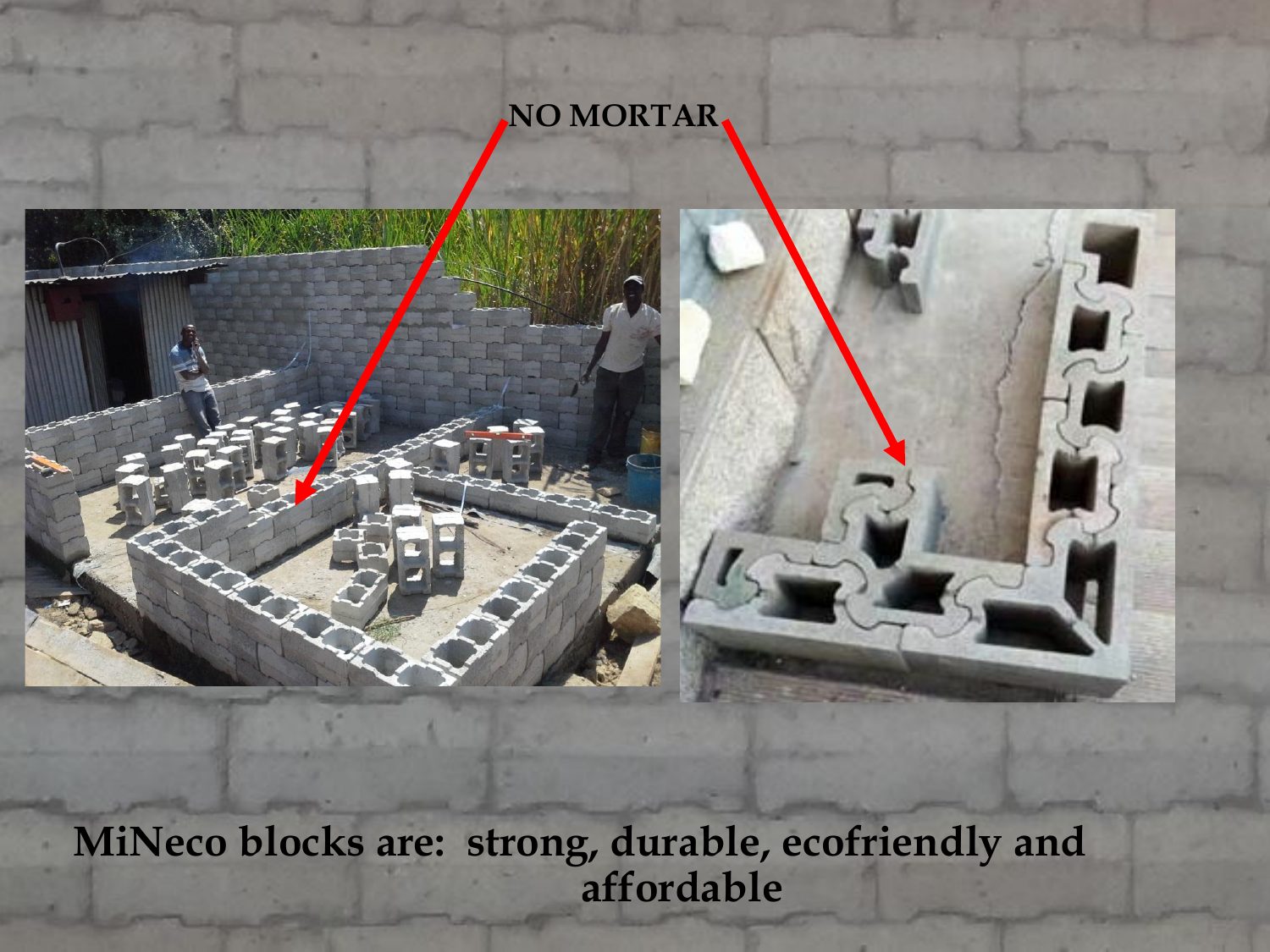
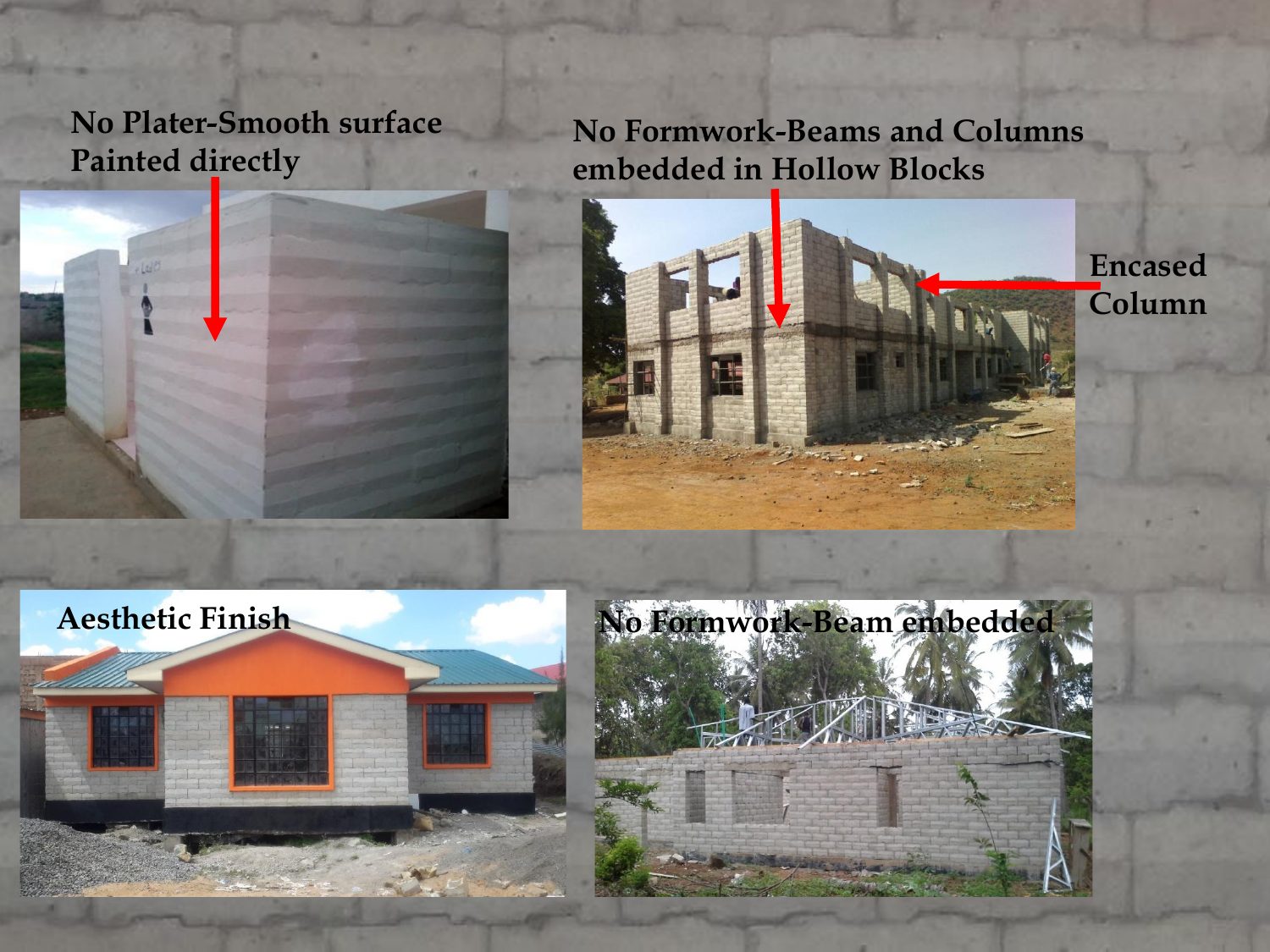
- No cement (mortar)
- No plaster
- Minimal formwork
- Minimal skilled labour
- Excellent thermal & acoustic insulation
- Community involvement in the build
- Aesthetic finish, eco-friendly
- 99% of materials reusable on demolition
- Robust and light — saves on structural grid
Foundations & slab
Suspended, not backfilled
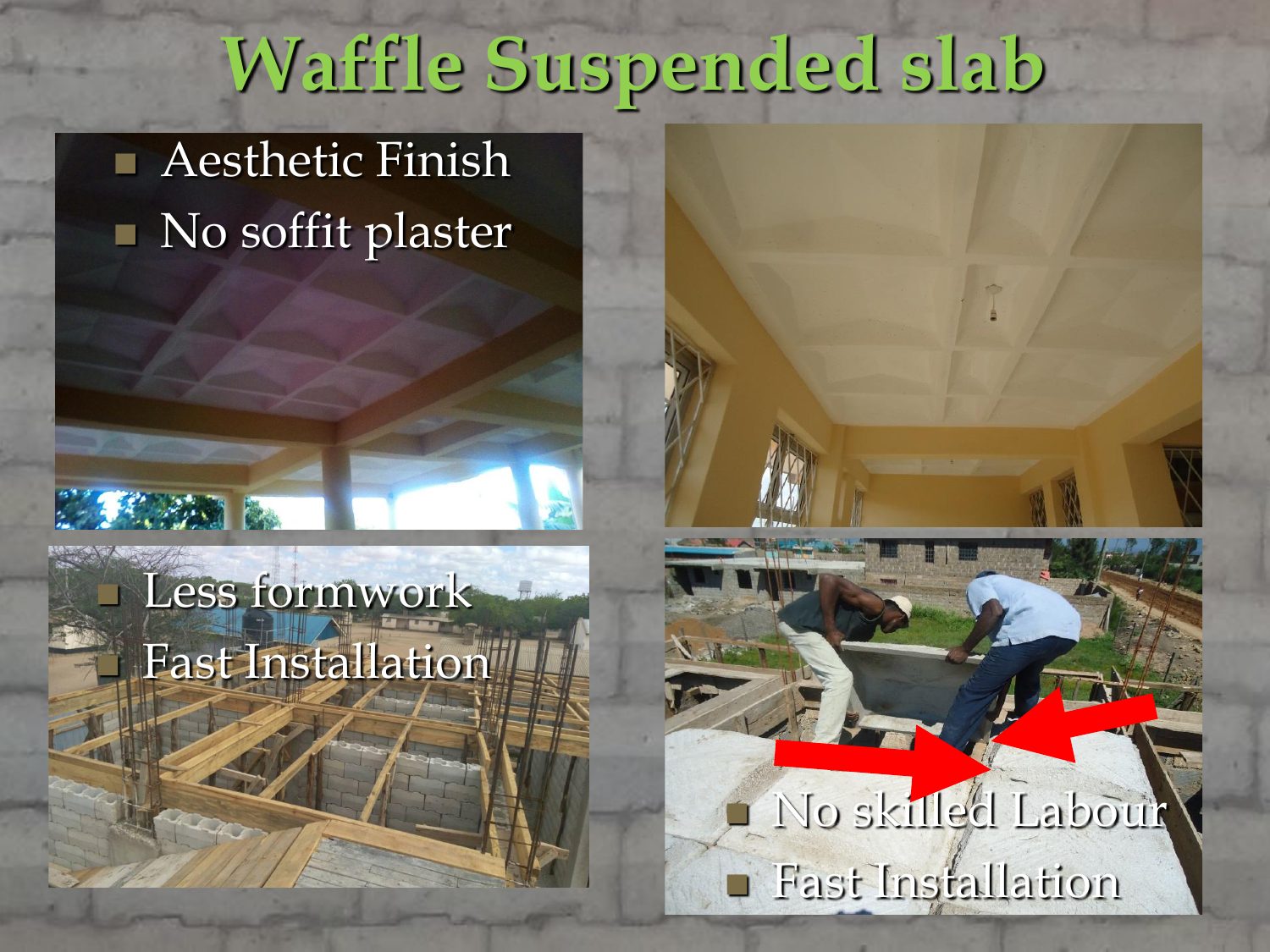
A suspended slab foundation means no dumping, no backfilling, and no foundation walling — with the void underneath doubling as storage and insulation. Steel bars sit at 1-metre centres, and conduiting is laid before the pour.
Portfolio
Built, not rendered.
A cross-section of residential and institutional work, with real sizes and shell/standard pricing where available.


Institutional & multi-storey


Project archive · 2013–2015 (click to expand)
| Project | Location | Cost (Ksh) | Code |
|---|---|---|---|
| 3 Bedroom Bungalow | Syokimau | 2,700,000 | 3BR-115B-D |
| 3 Bedroom Bungalow | Kitengela | 2,200,000 | 3BR-95B-S |
| 3 Bedroom Maisonette | Ruiru | 4,100,000 | 3BR-156M-C |
| 4 Bedroom Bungalow | Juja | 4,200,000 | 4BR-173B-D |
| 4 Bedroom Maisonette | Kitengela | 3,800,000 | 4BR-146M-D |
| 3 Bedroom Bungalow | Nanyuki | 3,400,000 | 3BR-75B-Sx2 |
| 4 Bedroom Bungalow | Malindi | 4,200,000 | 4BR-173B-D |
| 4 Bedroom Maisonette | Membly | 3,200,000 | 4BR-146M-C |
| 4 Bedroom Maisonette | Rongai | 6,200,000 | 4BR-274M-D |
| 3 Bedroom Bungalow | Machakos | 1,500,000 | 3BR-75B-C |
| 4 Bedroom Maisonette | Thika | 3,400,000 | 4BR-155M-C |
| 3 Bedroom Bungalow | Ngong | 2,200,000 | 3BR-95B-S |
| 3 Bedroom Bungalow | Embakasi | 2,400,000 | 3BR-95B-S |
| 177m Perimeter Fence | Karen | 1,400,000 | PW-177M |
| 62m Perimeter Fence | Umoja | 400,000 | PW-62M |
| Guard House | Kitengela | 400,000 | GH-25B-C |
| 2 Bedroom Bungalow | Nanyuki | 2,700,000 | 2BR-45B-Sx3 |
| Project | Location | Cost (Ksh) | Code |
|---|---|---|---|
| 3 Bedroom Bungalow | Embakasi | 2,700,000 | 3BR-115B-D |
| 5 Bedroom Maisonette | Kitengela | 4,600,000 | 5BR-205M-S |
| 3 Bedroom Maisonette | Ruai | 2,700,000 | 3BR-105M-C |
| 4 Bedroom Maisonette | Kitengela | 4,200,000 | 4BR-156M-C |
| 2 Bedroom Bungalow | Kapsabet | 3,200,000 | 2BR-45B-Sx4 |
| 4 Bedroom Maisonette | Nakuru | 3,800,000 | 4BR-146M-D |
| 3 Bedroom Bungalow | Homabay | 1,700,000 | 3BR-75B-S |
| 4 Bedroom Maisonette | Karen | 7,400,000 | 4BR-284M-D |
| Warehouse & Perimeter Wall | Kitengela | 9,300,000 | WH-200B-C |
| 4 Bedroom Maisonette | Kitengela | 4,600,000 | 4BR-184M-D |
| 2 Bedroom Flats | Mombasa | 12,400,000 | 2BR-205F-S |
| 3 Bedroom Bungalow | Limuru | 2,000,000 | 3BR-75B-D |
| 4 Bedroom Maisonette | Nairobi | 3,800,000 | 4BR-145M-C |
| 3 Bedroom Bungalow | Nairobi | 3,900,000 | 3BR-115B-C |
| 3 Bedroom Bungalow | Homabay | 2,200,000 | 3BR-75B-C |
| 3 Bedroom Bungalow | Naivasha | 6,600,000 | 6BR-325M-x2 |
| 4 Bedroom Maisonette | Nakuru | 3,800,000 | 4BR-146M-D |
| 5 Bedroom Maisonette | Ngong | 5,500,000 | 5BR-255M-C |
What we manufacture
Precast, priced, and in stock.
Six production yards manufacture our block, waffle and paving range. Prices vary by region — indicative ranges below.

Hollow Interlocking Block
Building · Construction. In stock.
Precast Concrete Pole
Building · Construction.
Precast Concrete Waffles
Building · Construction.
Stabilized Soil Blocks
Building · Construction. In stock.
Various Colours for Outside Finish
Building · Construction.
Product overview
Requirements & indicative pricing
| Product | Required / m² | Price range / piece (Ksh) | Use |
|---|---|---|---|
| Mineco HICB | 12 | 60–100 | Walling |
| Mineco HICBC | 14 | 40–60 | Walling — internal |
| Mineco Waffles | 1 | 800–1,400 | Slab |
Mineco vs conventional
Cost per element, supply & install
| Element | Mineco | Conventional | Includes |
|---|---|---|---|
| Suspended foundation | 6,200 | 9,500 | Column pads, column stubs, ground floor slab |
| Walling | 3,500 | 4,500 | Skimmed internally, ready for paint; external side finished |
| RC slab | 6,000 | 8,500 | Skimmed soffit, ready for paint |
Production capacity
Six yards, one supply chain
| Item | Zones | Rate/day | Units | Total/month |
|---|---|---|---|---|
| HICB blocks | 6 | 10,000 | pcs | 2,400,000 |
| Waffles | 6 | 1,000 | pcs | 120,000 |
| Baluster | 6 | 20 | pcs | 2,400 |
| Concrete posts | 6 | 100 | pcs | 12,000 |
| Cabro blocks | 2 | 20,000 | pcs | 800,000 |
| Copings | 6 | 200 | pcs | 24,000 |
| Graded ballast | 2 | 200 | tonnes | 800,000 |
Also at our centres
About the firm
Fifteen-plus years of building, one system.
General building and civil engineering construction, registered in Kenya in 2010 — over 15 years building, and now employing more than 100 people directly and indirectly.
Vision, values, leadership & more (click to expand)
- Residential and commercial buildings
- Schools, laboratories and swimming pools
- Renovations and interior design
- Project management, architectural & structural drawings, civil engineering
Vision
To be the best quality provider in executing construction work and providing affordable quality works using locally available eco-friendly materials, reliable to our clients, with professionalism maintained throughout.
Mission
To provide affordable quality building and civil engineering construction services through efficient, effective and sustainable use of available resources — meeting and exceeding the expectations of clients and stakeholders.
Core values
Community impact areas
Strong emphasis is placed on youth employment — involving local youth in the communities where projects are located, transferring technology and skills through hands-on work rather than long training programmes.
- Job creation — the system allows self-build
- Skill transfer — minimal training required
- Use of local materials
- Climate-responsive construction
Leadership & staff
Mate J. Njiru
Managing DirectorBSc in Civil Engineering, JKUAT. Extensive technical and commercial experience across construction companies in Kenya, with depth in project management, structural design and construction supervision.
Terry Kendi
Director / AdministratorDiploma in Purchasing and Supply, KIM. Serves as Finance Director, overseeing procurement and financing across the firm's projects.
John Inya
Manager, ProjectsDiploma in Architecture, Technical University of Kenya; Diploma in IT, JKUAT. Client-satisfaction liaison and QA officer.
Paul Kirui
Assistant Project ManagerDiploma in Civil Engineering, Technical University of Kenya. Over seven years in construction.
Zackary Ajuoga
Manager, MEPBSc in Mechatronic Engineering, JKUAT. Specialising in mechanical, electrical and plumbing services.
Dickson Maillu
Technical DirectorBSc in Construction Management, JKUAT. Heads tendering, payment certificates and variations.
Joel Mumo
Quantity SurveyorMA and BSc in Construction Management. Over eight years in the building and construction industry.
Yard and site team: Evans Osumba (Production/Execution); John Mawira (Yard Manager); Eliud Njoroge, Lincoln Gitonga (Site Team).
Group & sustainability
Sister venture — solar, wind & bioenergy
- Carbon accounting to quantify lifecycle environmental impacts and unlock climate funding
- R&D on alternative low-carbon materials — earth, second-hand/"waste" materials, LC3 cement
- Exploring digital tools (e.g. ENDELEVU) to support social projects
Get in touch
Let's talk about your build.
Call, WhatsApp or email — or visit the outlet nearest you.
Mineco House
MiNeco Energy
Solar, wind & bioenergy systems.
minecoenergy@gmail.com
Business hours
| Monday – Friday | 9am – 3pm |
| Saturday | Closed |
| Holidays | Closed |
| Support | 24/7 |
Find us
Regional outlets — 47 counties covered
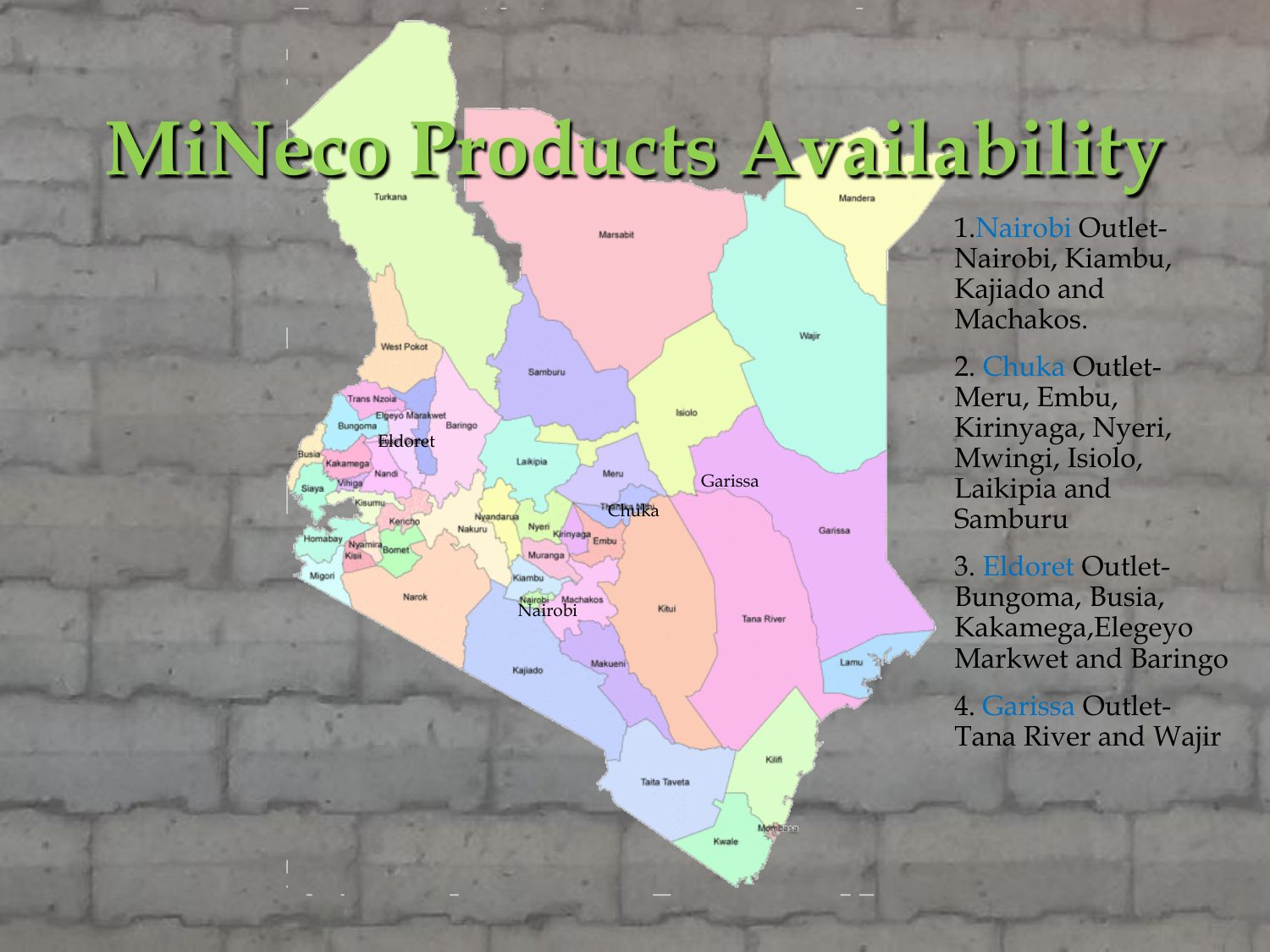
Nairobi outlet
Nairobi, Kiambu, Kajiado, Machakos
Chuka outlet
Meru, Embu, Kirinyaga, Nyeri, Mwingi, Isiolo, Laikipia, Samburu
Eldoret outlet
Bungoma, Busia, Kakamega, Elgeyo Marakwet, Baringo
Garissa outlet
Tana River, Wajir
In this order
Delivery principles
- Minimum time of construction45 days for bungalows, 90 for maisonettes — reducing overhead, labour cost and exposure to price fluctuation.
- Minimum cost of constructionLocally available materials and community labour, priced roughly Ksh 900,000–3,500,000 for a 2-bedroom bungalow through a 4-bedroom maisonette.
- Minimum labour requirementsSimple systems needing less skilled labour; in-situ community training within hours.
- Functional space allocationClients are guided to prioritise essential needs within local building by-laws.
- Eco-friendly materials and techniquesMinimal disruption to natural soil layering; trapped air in walls and slab insulates and buffers sound.
- Reduced timber useThe steel-frame roof system helps ease deforestation pressure.
- Bio-digester optionReplaces a septic tank, supplies cooking gas, and needs no desludging.
Tested to hold